

By Steve Towers | CX Obsession
“I rang about this on Monday.” If you’re reviewing calls for quality, pause the recording right there. Before you score the adviser on how well she handles Thursday’s call, find out what your organisation promised on Monday. Somewhere between those two conversations is work the customer has ended up doing for you.
Imagine the call is about a refund. Monday’s adviser confirmed that Finance had approved it. Thursday’s adviser looks at the same screen and gives the same perfectly accurate answer. Both calls might score well. Meanwhile, the customer has checked their bank account three mornings in a row and is still £80 short for the weekly shop. Nobody rang twice just to hear that it had been approved.
If you want to reduce repeat calls, give the people answering them a way to investigate what happens after they hang up. Then bring in the people who can change it. That’s where customer experience training can earn its keep. Let me show you what that looks like, starting with a bin that a collection crew couldn’t reliably find.
Eight missed collections and a note the crew couldn’t see
In a complaint investigated by the Local Government and Social Care Ombudsman, Eastleigh Borough Council told a resident it had logged eight missed bin collections between February and July 2022. His bin stood near commercial waste bins. Following staff changes, crews had confused the two. Notes about the bin’s location were missing from the recorder in the collection vehicle. The council said it corrected the information and arranged for a supervisor to speak to staff on collection day. Read the Ombudsman’s decision.
Think about which part of that case you’d use in a training room. I’d put the call handler and a relief driver together. Ask the call handler what the resident had already explained. Then give the driver the information that would have appeared in the cab that morning. Could somebody covering the round for the first time have found the right bin?
That small exercise changes the conversation. The call handler can discover that information visible in one department never reaches the person who needs it. The driver gets to explain what a usable location note looks like out on the round. And the resident has already supplied a perfectly good test of whether the change worked. Next collection day, go and look in the bin.
When a retailer gave customers one less reason to call
British footwear retailer Russell & Bromley faced a different problem. Once an online order left the business, it relied on its carriers to send delivery notifications. The retailer introduced its own notifications and tracking with Narvar. In the provider’s published case study, Nick Mitchell, then head of customer service and online trading, reported a 43% reduction in “Where is my order?” calls in the final quarter of 2020. The figure applies specifically to order-status calls over that period. Read the Russell & Bromley case study.
Put yourself in the buyer’s kitchen. You’re about to leave for the school run and want to know whether the parcel will arrive while you’re out. An order number is of little use to you. A reliable update gives you a decision you can make. That’s worth remembering before commissioning a dashboard which proudly reports how quickly advisers answer delivery enquiries.
These two cases point to different investments. One crew needed a location note in the cab. Online shoppers needed information while they could still act on it. Neither case establishes a return on training. What you can teach a team is how to distinguish those problems before somebody signs off money for the wrong solution.
A five-step framework for finding the reason behind repeat calls
Here’s how I’d run a first investigation. Choose one reason people get in touch, such as chasing a refund. Keep the scope small enough that someone on the team can follow an individual case from beginning to end. You’ll need an adviser, someone who owns the work after the call and a manager with the authority to change one thing. Give them access to the same cases.
1. Agree what the customer came to achieve
Ask each person to finish this sentence in the customer’s own language. “I’ll know this is sorted when…” Write the answers down separately before you compare them. For a refund, the adviser might write “I’ve explained when they’ll be paid.” Finance might write “We’ve released the payment.” A customer might say “The £80 is back in my account by Friday, as you promised.” Friday gives the team a deadline. The bank balance gives it a test.
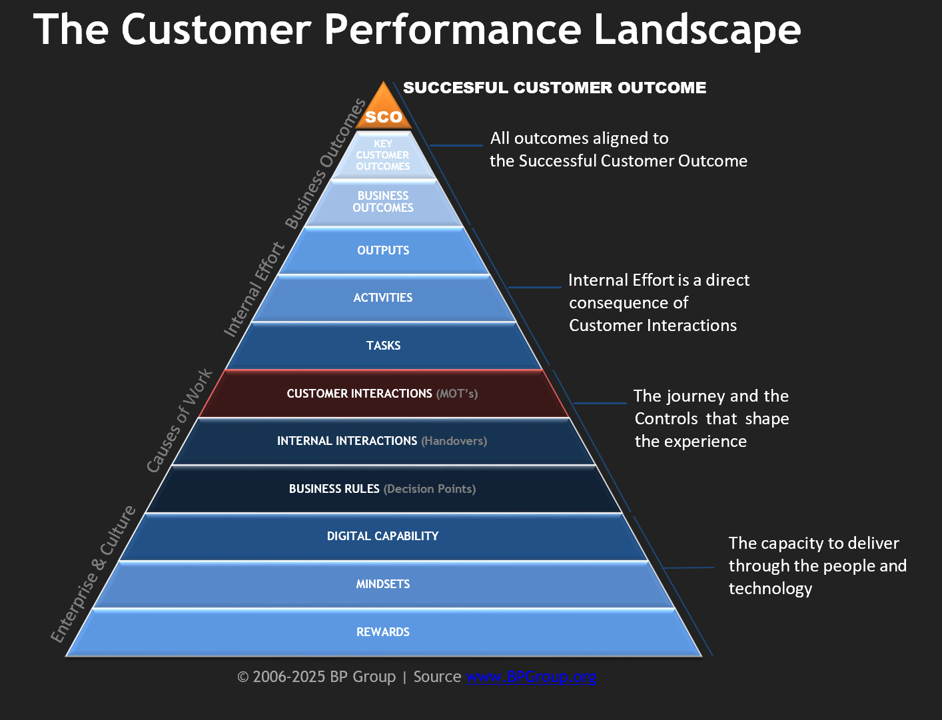
At BP Group we call this the Successful Customer Outcome. Treat your first version as a working assumption. Check it against what customers actually said. A person disputing an unexpected renewal may also need reassurance that the charge won’t recur next month. Restoring this month’s money settles only part of their concern. If your sample mixes those cases with ordinary returns, separate them before deciding what good looks like.
2. Reconstruct ten second contacts
Take ten recent cases where somebody got in touch again about the same issue. Start with their opening words on the second contact. Look up the earlier conversation, including email or chat, and record exactly what was promised. Then find the first point at which someone inside the organisation could have known that the promise was in doubt. Ten cases are enough to start a conversation. Estimating how common the problem is takes a wider sample.
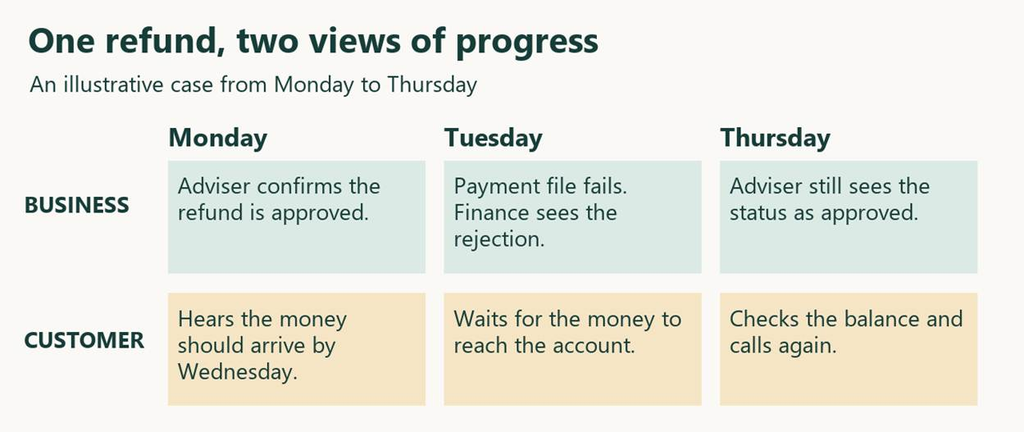
In the refund example, suppose the customer’s first email promised payment by Wednesday. The payment file failed on Tuesday afternoon. Finance could see the failure, customer service could see only “approved”, and the customer first discovered the problem by checking their balance. You now have a time, a decision and a person to investigate. “Improve communication between departments” suddenly looks like a rather vague instruction.
Capture one more thing while the case is open. Was that second contact avoidable? A customer ringing with new bank details is making a useful contribution. A customer repeating the details because the first team lost them has been given unnecessary work. Putting both calls in the same failure category will encourage somebody to suppress conversations you ought to welcome.
3. Work backwards to the decision that created the chase
Start at the point where the customer needed the outcome and ask what had to happen immediately beforehand. For money to be available by Friday, when did the payment provider need the instruction? Working back from that cut-off, when did Finance need to release it? At what point could the adviser safely promise Friday? Write actual times beside each answer. Where the team doesn’t know, record who can find out.
Give the customer a row on the same map. Mark when they checked their balance, reopened the chat or rearranged something because the money hadn’t arrived. A blank three-day gap on the company’s process map can be a rather busy three days for the person waiting. This is what I mean by looking at the experience from need-to-satisfaction. You keep following events until the customer can get on with what they were trying to do.
The most productive disagreement may come from the colleague who says, “We can’t see when their bank credits it.” Fair point. Record what your business can verify, such as a provider’s settlement confirmation. Then check a sample with customers who are willing to confirm receipt. Give these two facts different names on the dashboard. The distinction matters the next time someone proposes sending an email saying “Your refund is complete.”
4. Test one change somebody has the authority to make
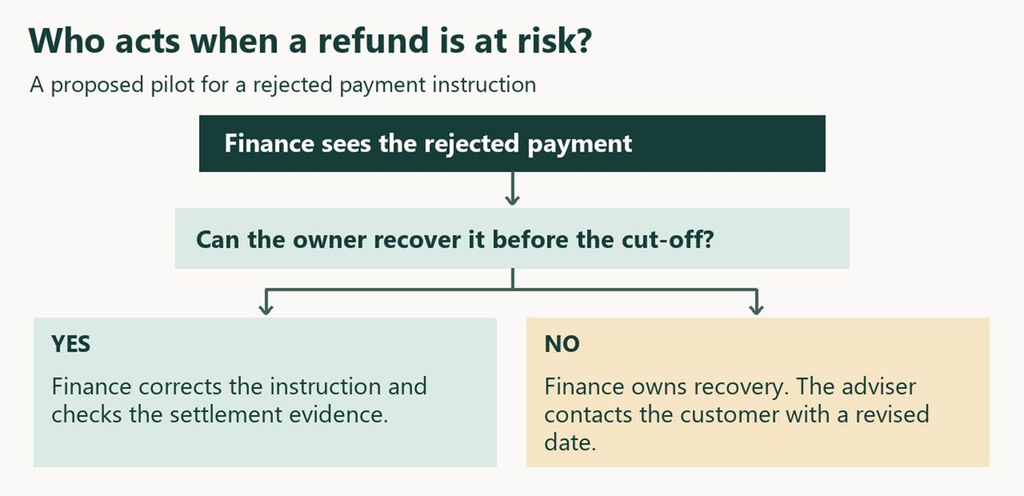
Choose the earliest point where you can prevent the failure or give the customer a useful choice. In the payment-file example, I’d start with the rejected instruction. Give a named colleague the information and authority to correct it before the cut-off. Agree who will contact the customer if the original date can no longer be met. Try this with one refund team and keep the existing route open for customers who need help.
Rehearse it with a case that goes wrong late on a Friday. The usual owner has gone home. The adviser has the customer on the phone and can see a rejection but doesn’t know whether a second payment would duplicate the first. Ask the team to show you how cover works and who can authorise the next action. Five minutes spent on that awkward case can expose more than an hour spent admiring a process map where everything works.
A useful training brief falls out of the rehearsal. Finance needs to recognise the exception and recover the payment. The adviser needs to interpret the status and give a date they can stand behind. The manager needs to make sure both can get a decision when the usual owner is away. You now know who needs to learn what, and which permission or system change they need alongside it.
5. Measure what customers received and what it cost to deliver
Keep two questions together in the weekly review. What proportion of customers received the correct refund by the promised date? What proportion had to get in touch again about it? The first tells you about delivery. The second tells you something about the effort you handed back to customers. If fewer people call but just as many payments are late, listen to the people who stopped calling before declaring success.
Agree the counting rules before the pilot. Use the refund case as the unit. Count a case once if the customer chases through any channel, even if they phone twice and send an email. Count the actual number of chases separately when you calculate workload. Use the same follow-up window for both groups and give the last refund in each group time to reach its due date. Otherwise the newest group can appear to perform best simply because fewer people have had time to complain.
A worked example your finance director can challenge
Suppose you compare two groups of 200 refund cases with similar payment methods and promised timescales. The numbers below are illustrative. They show the calculation I’d want to see before anyone put a saving in a business case.
| Measure | Before | Pilot |
| Refunds received in full by the promised date | 170 / 200 (85%) | 190 / 200 (95%) |
| Cases with at least one customer chase | 37 / 200 (18.5%) | 20 / 200 (10%) |
| Total incoming chases across all channels | 55 | 30 |
On these figures, an extra 20 customers per 200 received the money on time. Seventeen fewer customers had to chase. Advisers handled 25 fewer incoming contacts because some people in the earlier group had chased more than once. Those are three different results. The person managing the queue needs the last figure. The person accountable for the refund needs the first.
Now put some money against it. At an assumed £4 of staff time per incoming chase, 25 fewer contacts releases £100 of capacity across 200 refunds. Suppose the new exception check takes an extra two staff hours at £25 an hour. That leaves £50 of capacity at those assumed rates. A manager still has to decide what to do with the time. If staffing and overtime stay the same, it won’t appear as £50 off the wage bill.
I’d also look at the ten pilot refunds that still missed the promise. Did the change work only for straightforward card payments? Was one customer’s wait particularly long? Two groups observed at different times can differ for reasons beyond the pilot. Repeat the comparison over another period or against a comparable team before promising the finance director an annual figure. You already have better grounds for deciding what to test next.
What to ask before you book CX training
If you’re commissioning customer service training, ask the sponsor to bring one real case to the briefing. Let an adviser talk you through what they could see at the time. Ask the colleague who owns the next step to explain what happened after the call. Then ask the budget holder which decision those two colleagues will be allowed to change when they come back from training. The answer may change the guest list.
Here’s the trap. You send twelve advisers on a course. They return knowing exactly why customers chase. Their team leader still measures them on how quickly they close the call, and the payments team still has no way to tell them when a transaction fails. Six weeks later, everyone is disappointed with the course. You can get really good at doing dumb stuff that way, and spend quite a lot on it too.
I’d start smaller. Pick a reason for contact where customers have already told you what went wrong. Give one adviser and one operational colleague time to follow the evidence. Put their manager’s name against the decision to be made. Book a date to examine the next batch together. At that meeting, leave the course satisfaction scores until last. Start with somebody who got their money on time, or somebody who didn’t, and find out why.
Bring your second call to ACX Master
If you’re developing your own CX skills, choose a recurring complaint you’d like to tackle and bring it to an ACX Master® open session. If you’re commissioning training for a team, bring the colleague who hears the complaint and the colleague who can change what happens next. When you speak to us at BP Group, tell us what customers are chasing and what you’ve already tried. That gives us a much better starting point than a request to “make everyone more customer-centric”.
See upcoming ACX Master® sessions and choose a cohort.
Related reading on CX Obsession
For the next leadership meeting, my article on embedding Outside-In practice explains how to put a Successful Customer Outcome on the scorecard and review it with the people who own the work. Embedding Outside-In thinking and practice in organisations
If your starting point is a process improvement project, this interview explores how to connect everyday work to customer outcomes and the commercial decisions behind it. How you can drive customer centricity through the power of process

Steve has also published many articles and conference keynotes (see the MOT primer below) reviewing the continued evolution of this fascinating concept.
Join us at a coaching session and become qualified in Customer Centric and Process Transformation https://www.bpgroup.org or visit https://www.stevetowers.com
Definitions
What is a Moment of Truth?
A Moment of Truth is any interaction with the customer within the Customer Experience, first discussed in my 1993 book ‘Business Process Reengineering – A Senior Executive’s Guide‘
Moments of Truth are the cause of all work.
This understanding underpins the CEMMethod, first launched in 2006 and now in version 15. It is the idea that all work an organisation undertakes is, at a fundamental level, caused by Moments of Truth. In principle, everything a company does can and should be linked to a Moment of Truth.
Managing Moments of Truth
Enlightened ‘Outside-In’ organisations actively embrace Moment of Truth Management as an essential strategic and operational necessity to deliver engineered Customer Experiences. How so?
a. Designing for Moments of Truth – The Design-Implementation Gap
Early efforts were geared towards designing optimal Moments of Truth; however, simply mapping customer journeys has never been enough. It is one thing to agree on what a future state customer journey should be; it is entirely another to implement it. This Design-Implementation gap is precisely what kills the majority of Customer Experience initiatives.
b. Implementing optimised Moments of Truth
Successful deployment of innovated Moments of Truth is key to delivering optimal Customer Experiences. The most practical immediate results focus on a rapid rollout across a key experience, using the success of that rollout to validate the smooth rollout across the organisation. Establishing ownership, accountability, metrics, controls and improvement paths are part of this discipline.
c. Operationalising Moments of Truth
Once Moments of Truth have been designed, innovated and implemented into recrafted customer experiences, they need to be actively managed ‘in the moment’ and shared. Every Moment of Truth should feed to a corporate dashboard, with real-time data showing the performance of that MOT and its associated experiences. If things go wrong, the owner should be able to ‘course correct’ and real-time monitor the customer experience delivery.
Imagine a world without customer satisfaction surveys, no need for Net Promoter Scores, no focus groups, and no mystery shopping because you will know how 100% of interactions are performing 100% of the time.
Control and Action combined
The C-suite and leaders will now have a clear line of sight into every corner of the organisation and across the enterprise landscape, in real-time. One version of the data truth (and not all those departmental/divisional versions of reality).
The need for retrospective action evaporates. Immediate and laser-focused control can be maintained, delivering simultaneously enhanced service, lower costs, higher revenues, improved compliance and uber motivated employees.
MOT primer…
Steve Towers
https://www.linkedin.com/in/stevetowers/
Richard Normann – creator of the Moments of Truth concept:
https://en.wikipedia.org/wiki/Richard_Normann
Jan Carlzon – author of ‘Moments of Truth’
https://en.wikipedia.org/wiki/Jan_Carlzon
Moments of Truth 2025 (VIDEO)
https://youtu.be/3mzz_LdgmFY
That Kodak Moment of Truth
https://www.processexcellencenetwork.com/innovation/columns/4-lessons-from-the-kodak-moment-of-truth
Mitch Belsley – Get Scientific about Managing Moments of Truth
http://customerthink.com/get-scientific-about-managing-moments-of-truth/
Accreditation & Certification in CX and Process
https://www.bpgroup.org